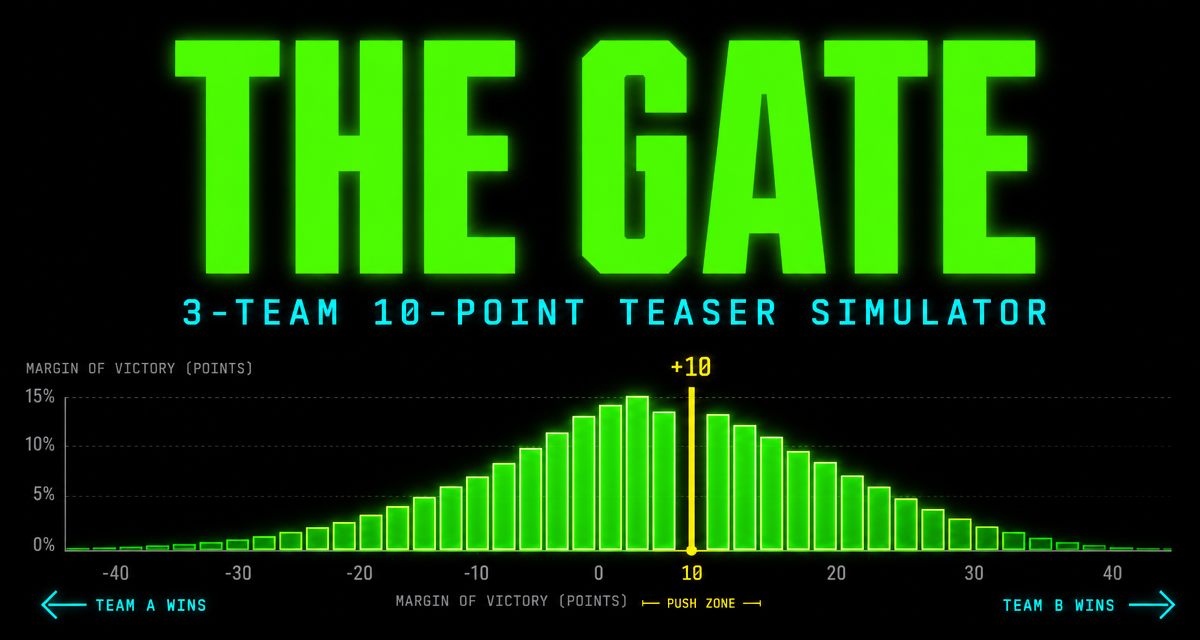
 Teasers
Totals OnlyTotals
The Process CFBCFB
The Process NFLNFL
TigerPicksSEC
CFB Gridiron EdgeCFB
Gridiron PrognosisFootball
BullringHorses
First OverHarness
ScorePredictorScores
FantasyGolfGoldGolf
Sports Prop MadnessProps
Teasers
Totals OnlyTotals
The Process CFBCFB
The Process NFLNFL
TigerPicksSEC
CFB Gridiron EdgeCFB
Gridiron PrognosisFootball
BullringHorses
First OverHarness
ScorePredictorScores
FantasyGolfGoldGolf
Sports Prop MadnessProps
 Fourth Wall — CFB backward-induction solver How to use →
How to use Fourth Wall
- Pick the two teams and set home field under Teams.
- Enter the live situation under Game state: clock, score, down, distance and yards to the goal line.
- Press Solve the window once. It solves the full game backwards from 0:00.
- Read Win probability for that exact spot, and the fourth-down panel for go, kick or punt.
- Scroll to the market table for total, spread and teaser leg prices from ten thousand simulated games.
- Adjust anything under Parameters if you trust your own numbers, then solve again.
Solves a college football game backwards from zero, then plays it forward under the solved policy to price the market.
Solve window
The game is solved backwards from zero across the full sixty minutes, so any clock you enter is covered.
Game state
The situation you want priced.
Teams
Picking a team fills in its 2025 final yards per play, above or below the FBS average. Offense is yards per play gained above average, defense is yards per play prevented, so a positive number is good on both sides. Edit any figure by hand and it stays until you pick again. Ratings are regressed toward the average before the model uses them, because one season of yards per play does not repeat exactly in one game; taking them at face value made favourites far too certain. The strength of that regression is the rating reliability setting in the parameters.
Pace is not in the ratings and stays where you set it. It is the strongest single lever on a total, so set it before you trust one. Home field is set in points of margin and split evenly between the home offense and defense; the conversion was calibrated against the model, not assumed.
Solve the window to see the value surface across the field.
The decision
Win probability under each option at this exact state.
| — |
Situation call
What the offense should call here, and what it is worth. The solver chooses run or pass; which kind is read off the distance, how much of the defence is sitting on the run, and the tempo it picked.
| — |
How fast this is moving
What one unit of each state variable is worth in win probability right now. Large numbers mean a high-leverage snap and a live line that should be moving fast.
| — |
Priced from the score distribution
Ten thousand games played forward from this state under the solved policy. Enter the numbers you are being shown and compare.
—
Model parameters
Every number the solver runs on. Yardage figures are means per play for that call against that defensive call. Change anything here and solve again.
Calibration against known win probabilities
Seven situations where the answer is well established. Tune the parameters until these line up with numbers you trust, then use the solver. The model currently runs confident on leads: timeouts are collapsed out of the state space, so a trailing team has fewer ways to stop the clock than it really has.
| — |
Overtime
The solver treats every play as a simultaneous call: the offense picks run or pass, the defense picks which to defend, and the value of the state is the equilibrium of that matrix rather than the best case for either side. Time is carried as a fraction of a slice and interpolated between them, so a play never silently costs more clock than it took. A team that is already winning is not maximising win probability, it is protecting one, so among options that come out effectively tied the solver prefers the one that burns clock and holds the ball when ahead, and the reverse when behind. The same applies on fourth down: failing on a conversion is a turnover at the line of scrimmage where a punt is the same change of possession forty yards downfield, so a leading team takes the safe version of a tie. A kick earns that credit only in proportion to how often it is made. That nudge is deliberately small: it decides a settled game and does nothing to a live one. The run/pass split is an equilibrium mix: the rate at which a defense cannot exploit you. It is not a forecast of the next snap. Against real CFB call rates it sits about 13 points off on average, so it is the wrong number to price a single play-by-play run/pass market against — a team's own charted tendency beats it there. Use this split for what a call is worth, and your charting for what is coming. The error is smallest on first down and medium yardage and largest on second and long. Team ratings are 2025 final yards per play from TeamRankings, expressed as a gap from the FBS average across 137 teams. They are last season's numbers, so treat them as a prior and shrink them hard until this season has a real sample. The remaining yardage, turnover and clock parameters are priors, not measurements — put your own charting numbers in before betting anything off it. Two simplifications worth knowing: timeouts are not in the state space, and field position is carried in five-yard bands, so goal-line and two-minute states are the least trustworthy part of the surface.
A college football win probability and fourth-down calculator
Fourth Wall solves a college football game the way a dynamic program solves any finite game: from the end backwards. It starts at 0:00, where the result is already known, and works back through every combination of time, score, down, distance and field position until it reaches the snap you care about. At each state the offense and defense pick simultaneously, so the value is the equilibrium of that matrix rather than the best case for whoever you happen to be rooting for.
That gives you the policy. Playing it forward ten thousand times gives you the distribution, and the distribution is what prices a market: the fair number on a side, on a live total, and on a teased leg. One solve answers all three, because they are all questions about the same set of final scores.
What it answers
- Fourth-down decisions. Go, kick or punt, with the win-probability cost of each alternative and the field goal priced from your exact yard line.
- Live win probability. For any state, with the value surface drawn across all 100 yards so you can see where the decision boundaries sit.
- Play calling. The equilibrium run/pass split, the tempo the solver chose, and the concept the situation calls for: a draw against a light box on second and long, a nine-yard hook on third and eight.
- Market pricing. Fair odds on the side, the total, the spread and a 10-point teaser leg, taken from the simulated distribution of final margins.
- Leverage. What ten yards, one minute, a field goal or a touchdown is worth in win probability right now, which tells you how fast a live line should be moving.
Questions
Should I go for it on fourth and short?
Fourth Wall answers that for your exact state rather than from a static chart. It shows the win probability of going for it, kicking and punting side by side, and the cost in win probability of taking the wrong one. At a tied game with fifteen minutes left it goes for it on fourth and one to three from anywhere on the field, and punts on fourth and eight or longer from inside its own forty.
How does a backward-induction solver work?
It starts at 0:00, where the answer is known, and works backwards one time slice at a time. Every earlier state is valued from the states it can reach, so by the time it reaches your snap it already knows what every outcome is worth. Play calls are solved as a two-by-two zero-sum game at each state rather than assuming either side knows what the other will do.
What is the difference between an equilibrium play call and a team's tendency?
An equilibrium mix is the rate at which a defense cannot exploit you. A tendency is what a team actually does. They are not the same and the gap is often large: on third and long real offenses pass far more than equilibrium says they should, which is exploitable and defenses do exploit it. Use the split for what a call is worth and your own charting for what is coming.
Can it price a 10-point teaser leg?
Yes. The solver produces a policy, then ten thousand games are simulated forward under that policy to build a full distribution of final margins. That distribution gives the probability of a straight cover, of a teased cover, and the number of percentage points the teaser actually buys, which matters because margins cluster on 3, 7, 10 and 14.
Where do the team ratings come from?
Offensive and defensive yards per play for all 137 FBS teams, taken from the 2025 final season figures and expressed as a gap from the FBS average. They are last season's numbers, so they are a prior rather than a measurement. Every rating is editable and the model runs on whatever you put in.
How accurate is it?
Against seven situations with well-established win probabilities it is about six percentage points off, and it runs confident on leads because timeouts are not in the state space. Against real CFB play-call rates it is about thirteen points off, closest on first down and medium yardage. Both figures are shown inside the tool so you can see the error rather than take the output on faith.
Terms
Backward induction. Solving a game from its final state backwards, so every decision is valued by what it can still lead to.
Nash equilibrium. A pair of mixed strategies where neither side can improve by changing unilaterally. On a football snap it is the run/pass rate a defense cannot punish.
Saddle point. A state where one call beats the other against either defense, so there is nothing to mix: third and fifteen, for example.
Teaser leg. A single game inside a teaser, with the line moved in your favour. A 10-point teaser through 3 and 7 buys the probability mass sitting on the key numbers.
Pace of play. Seconds of game clock per snap. It is the largest single lever on a total: a 20-second offense and a 36-second offense differ by roughly sixteen points a game.